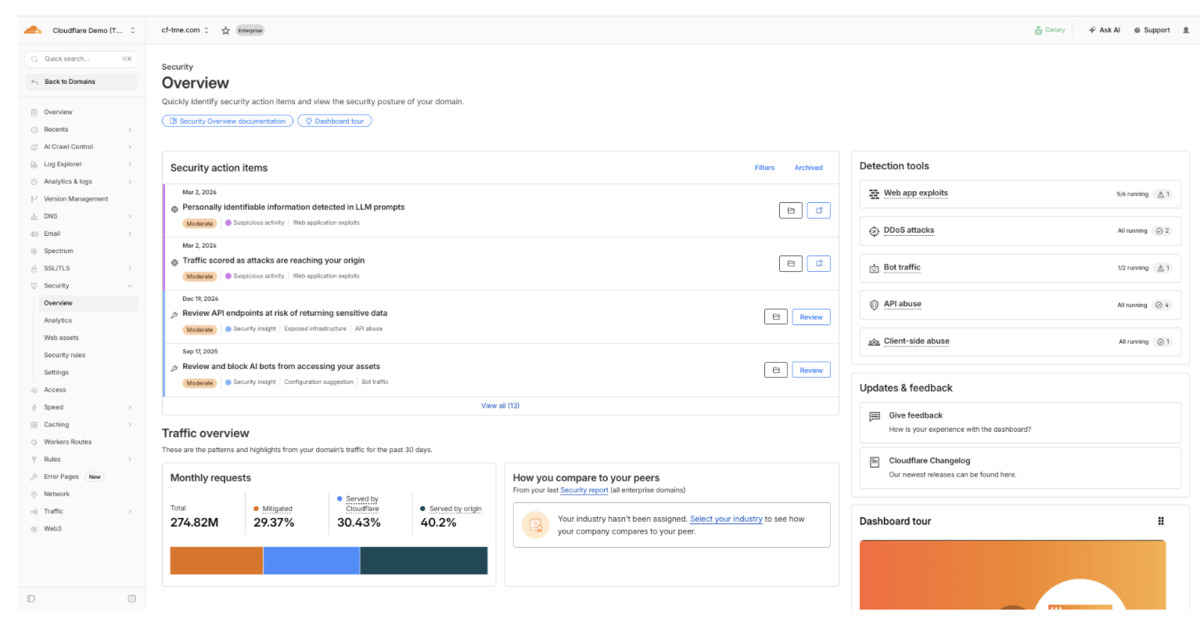
Cloudflare has launched a revamped Security Overview dashboard designed to consolidate fragmented security signals into a single interface that emphasizes actionable insights over raw data visibility. The update addresses a longstanding challenge in security operations, quickly identifying what requires immediate attention without navigating multiple tools or dashboards.
The new dashboard introduces a concept called Security Action Items, which surfaces vulnerabilities and misconfigurations and ranks them by severity. These items are categorized as critical, moderate, or low priority, allowing teams to triage risks based on urgency. The feature acts as a bridge between detection and remediation, enabling organizations to move from identifying issues to resolving them without additional investigation overhead.
/filters:no_upscale()/news/2026/05/cloudflare-security-dashboard/en/resources/1cloudflaredashboard-1776822348721.jpeg)
The new Security Overview dashboard (Source: Cloudflare Blog Post)
Cloudflare also emphasizes contextual awareness by allowing users to filter insights by categories such as suspicious activity or insecure configurations. This aligns the dashboard with real-world operational workflows, where different teams focus on specific threat vectors. Additionally, the platform highlights whether protections such as WAF rules or API security controls are actively enforcing policies or operating in passive log-only modes, helping teams validate their defensive posture in real time.
In a LinkedIn post, Sergio Bentim described the intent behind the redesign:
Cloudflare's Security Overview dashboard transforms raw data into a prioritized defense strategy. We’re empowering teams with the context required to act fast on what actually matters.
A notable usability improvement is the integration between the overview dashboard and deeper analytics workflows. Suspicious activity surfaced in summary cards can be directly explored in the Security Analytics interface with pre-applied filters, eliminating the need to recreate queries manually. This reduces context switching and accelerates incident response by keeping investigations within a continuous workflow.
From an architectural perspective, Cloudflare highlights the scale and complexity behind generating these insights. The system produces more than 10 million actionable insights daily, driven by a distributed set of microservices referred to as checkers. Each checker focuses on a specific domain, such as DNS configuration or API security, and operates either through scheduled evaluations or real-time event listeners. This design enables horizontal scalability while maintaining coverage across a broad attack surface.
Industry sentiment around unified platforms is also reflected in broader commentary. In a separate LinkedIn post, Janine Graham noted:
Cloudflare could fit your bill! Resilience, Speed, Access, Security, and AI all rolled into one.
Cloudflare stated that while the current experience is launched at the domain level, its roadmap includes expanding visibility to the account level, enabling enterprises to aggregate and prioritize risks across all domains from a centralized view. The company emphasized that its architecture of specialized checkers and real-time event handlers is designed to detect risks early and enrich them with context, helping security teams respond more effectively. The Security Overview dashboard is positioned as a primary entry point for daily operations, where risk signals are translated into prioritized actions.