Meta’s big moment is here. The Meta Superintelligence Labs has launched Muse Spark, its first AI model aiming at “personal superintelligence.” The journey to this point has been eventful, from building the widely adopted Llama family of open-source models to aggressive talent acquisitions that sent shockwaves through the AI industry.
But the backstory is not the only reason to pay attention. Muse Spark already powers the Meta AI app and website, with a rollout planned across WhatsApp, Instagram, Facebook, and Messenger.
That kind of reach makes this impossible to ignore. Here is everything you need to know about Meta’s latest AI, its core features, claimed performance, and how it holds up in real-world testing.
What is Muse Spark?
At its core, Muse Spark is Meta’s newest large language model and the first model in its new Muse family. But that description alone is far from the full story. Meta presents Muse Spark as a small and fast model that can still handle more serious reasoning tasks. That means it is not being pitched as just another chatbot brain. It is being positioned as the base layer for a smarter Meta AI that can think through tougher questions, understand images, and support more complex tasks across Meta’s ecosystem.
And this is exactly what makes Muse Spark different. Meta is not introducing it as a standalone lab demo meant to impress AI researchers on the internet for a few days. It is introducing Muse Spark as a product-first model that already powers the Meta AI app and website. The company also says the model is designed for multimodal tasks, stronger reasoning, and faster responses, with larger Muse models already in development. In simple words, Muse Spark is Meta’s attempt to build an AI model that actually helps people within the apps they use every day.
For this reason, it comes with several core features, like…
Muse Spark: Features
Meta has kept the feature set of Muse Spark fairly focused in the launch. Instead of throwing a long list of flashy abilities at users, it highlights three major areas that show where the model is meant to be useful.
Contemplating Mode
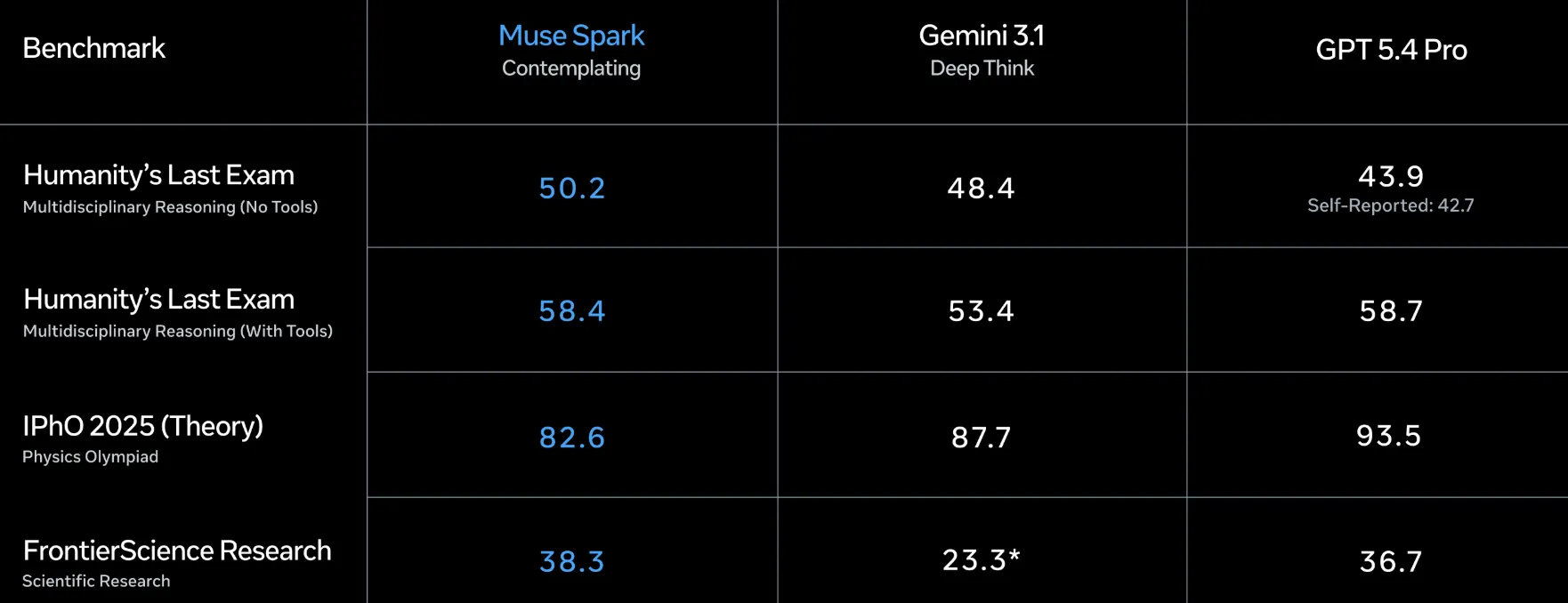
One of the biggest features in Muse Spark, Contemplating mode orchestrates multiple agents that reason in parallel. Meta says that this allows the model to take on harder tasks with deeper reasoning. The company positions it as a way for Muse Spark to compete with the high-reasoning modes of frontier models like Gemini Deep Think and GPT Pro.
Meta also backs this claim with numbers, saying Contemplating mode reaches 58% on Humanity’s Last Exam and 38% on FrontierScience Research.
Multimodal
Muse Spark is also built to work with visual information from the ground up. Meta says the model can handle visual STEM questions, entity recognition, and localization, making it useful across a wider range of tasks than plain text-based systems. This capability also feeds into more interactive use cases, such as creating mini-games or helping users troubleshoot household appliances with dynamic annotations.
Health
This is a new one and one of the core areas of the Muse Spark that Meta has clearly prioritised. The company says it worked with over 1,000 physicians to curate training data that improves Muse Spark’s health reasoning abilities. As a result, the model is designed to give more factual and comprehensive health-related responses. Meta also says Muse Spark can generate interactive displays to explain things like the nutritional content of foods or the muscles activated during exercise.
Altogether, these features make Meta’s direction with Muse Spark quite clear. This model is being positioned as a more thoughtful, more visual, and more practical system for everyday life. And there is quite a specific architecture that makes all of this possible.
Let us have a look at it in detail.
Muse Spark: Architecture
Meta explains Muse Spark through three scaling axes: pretraining, reinforcement learning, and test-time reasoning. In simple words, this is the company’s way of showing where the model gets its core intelligence from. It also tells us how that intelligence is improved after initial training, and how it is made more effective while answering real user queries.
Pretraining
This is the stage where Muse Spark builds its basic abilities in multimodal understanding, reasoning, and coding. Meta says it rebuilt this entire stack over the last nine months, improving the model architecture, optimisation process, and data curation. According to the company, these changes allow Muse Spark to reach the same capability level with vastly less compute than Llama 4 Maverick. That is a major claim, because it suggests Muse Spark is not just stronger, but also far more efficient.
Reinforcement Learning
After pretraining, Meta uses reinforcement learning to further improve the model. The company says this phase delivers smooth and predictable gains, despite large-scale RL often being unstable. More importantly, Meta claims these gains are not limited to the training data alone. Muse Spark also improves on held-out evaluation tasks. This suggests that the extra training generalises beyond the exact problems it has already seen.
Test-Time Reasoning
This is the part that controls how Muse Spark “thinks” before responding. Meta says it uses thinking time penalties to make the model spend its reasoning tokens more efficiently, instead of simply producing longer chains of thought. The company also uses multi-agent orchestration here, allowing several parallel agents to work on a hard problem together. According to Meta, this gives Muse Spark stronger performance at comparable latency. This will come in mighty handy if the company wants to serve this capability to billions of users.
The Muse Spark architecture tells you exactly what Meta is trying to do with it. The goal is not only to build a more capable model, one that scales efficiently, reasons better, and stays practical enough to deploy across the Meta products.
And the model has already proven its worth in benchmark performances.
Muse Spark: Benchmark Performance
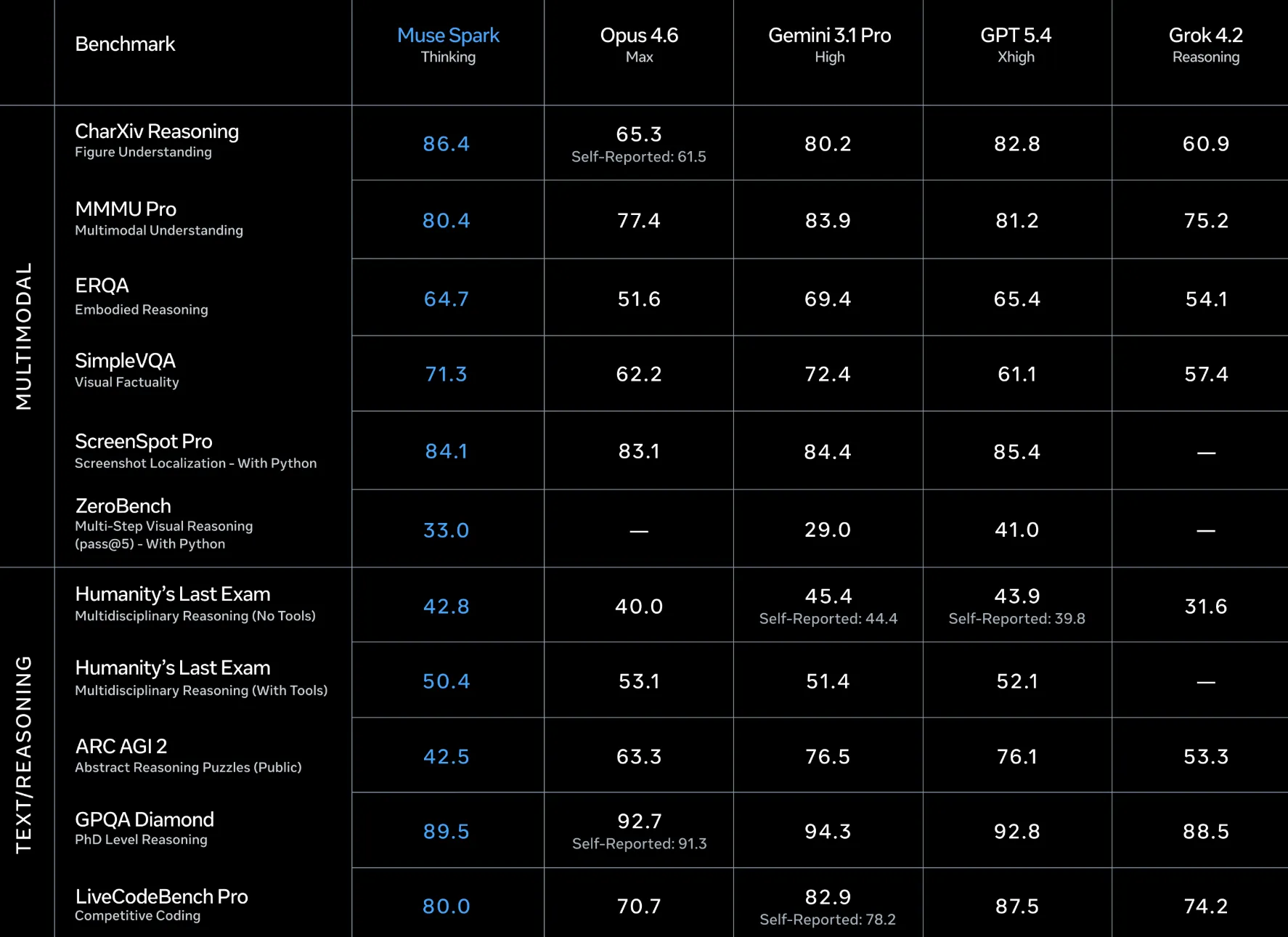
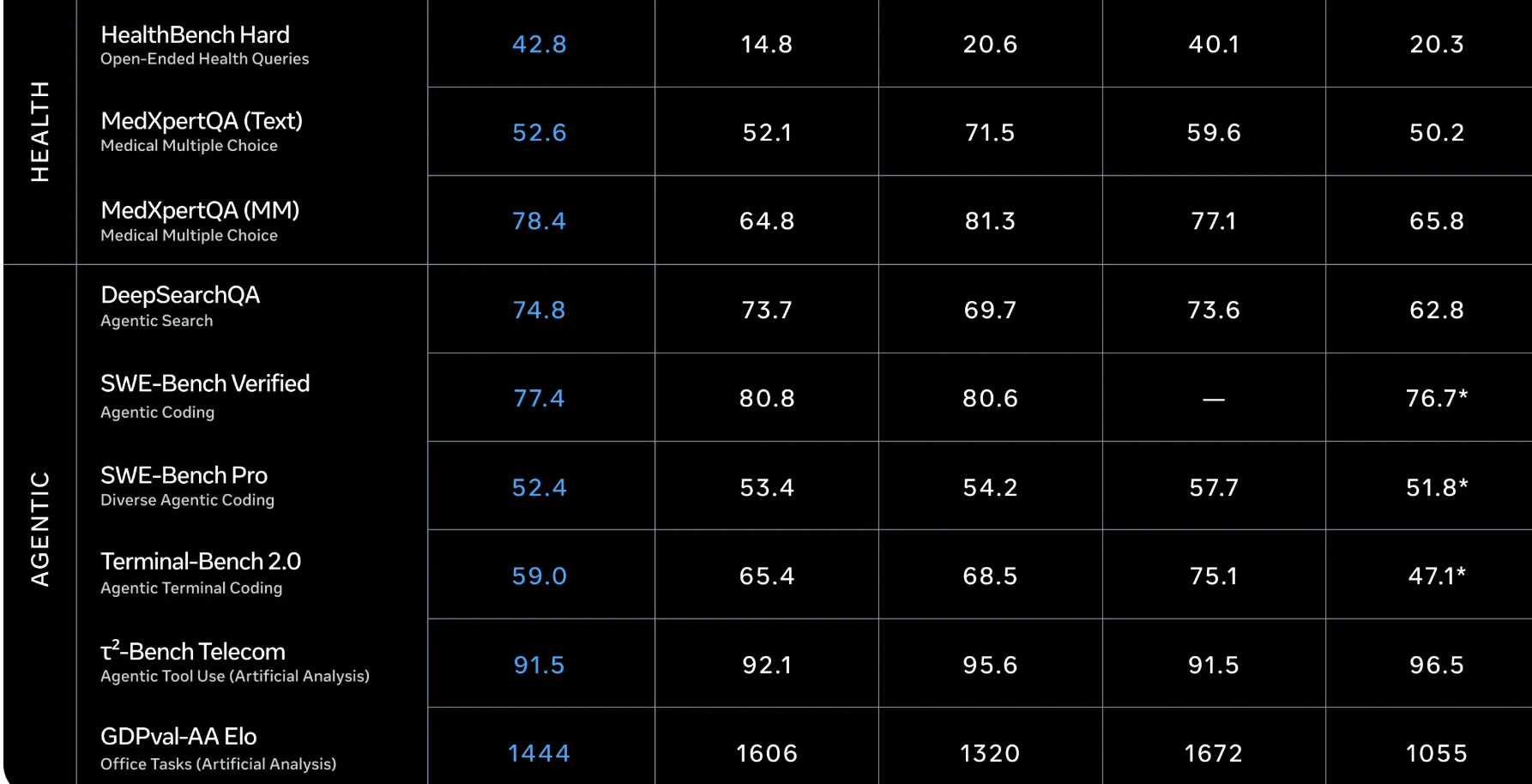
Muse Spark looks strongest in exactly the areas Meta is pushing hardest. At the risk of repeating myself, these are: multimodal understanding, health, and deeper reasoning through Contemplating mode. The model scores 86.4 on CharXiv Reasoning, showing strong figure understanding. It also performs well on HealthBench Hard at 42.8 and MedXpertQA (MM) at 78.4, which supports Meta’s claim that health is one of the model’s key focus areas. Its Contemplating mode strengthens the reasoning story, pushing Muse Spark to 50.2 on Humanity’s Last Exam (No Tools) and 38.3 on FrontierScience Research, ahead of some top frontier competitors in these comparisons.
If I were to sum it up, Muse Spark looks most convincing when the task involves visual understanding, health-related reasoning, and harder multi-step thinking.
That said, we should note that the results do not show a clean benchmark sweep. On some broader reasoning, coding, and agentic evaluations, stronger rivals still remain ahead, especially on tests like ARC AGI 2 and parts of coding performance. So the bigger takeaway is fairly clear: Muse Spark does not look like the strongest all-round frontier model yet. Though it does show clear and credible strength in the exact areas Meta seems to have built it for.
Muse Spark: How to Access
Meta’s new AI model is already up for use. You can access it in the following ways:
Go to the meta.ai platform and use it through the chat interface
Download the Meta AI app on your phone and use it
Meta has also said it is opening a private API preview to select users, which means broader developer access is still limited for now.
Once you access it, here is an example of the kind of outputs you can expect from the model.
Let’s Try Muse Spark
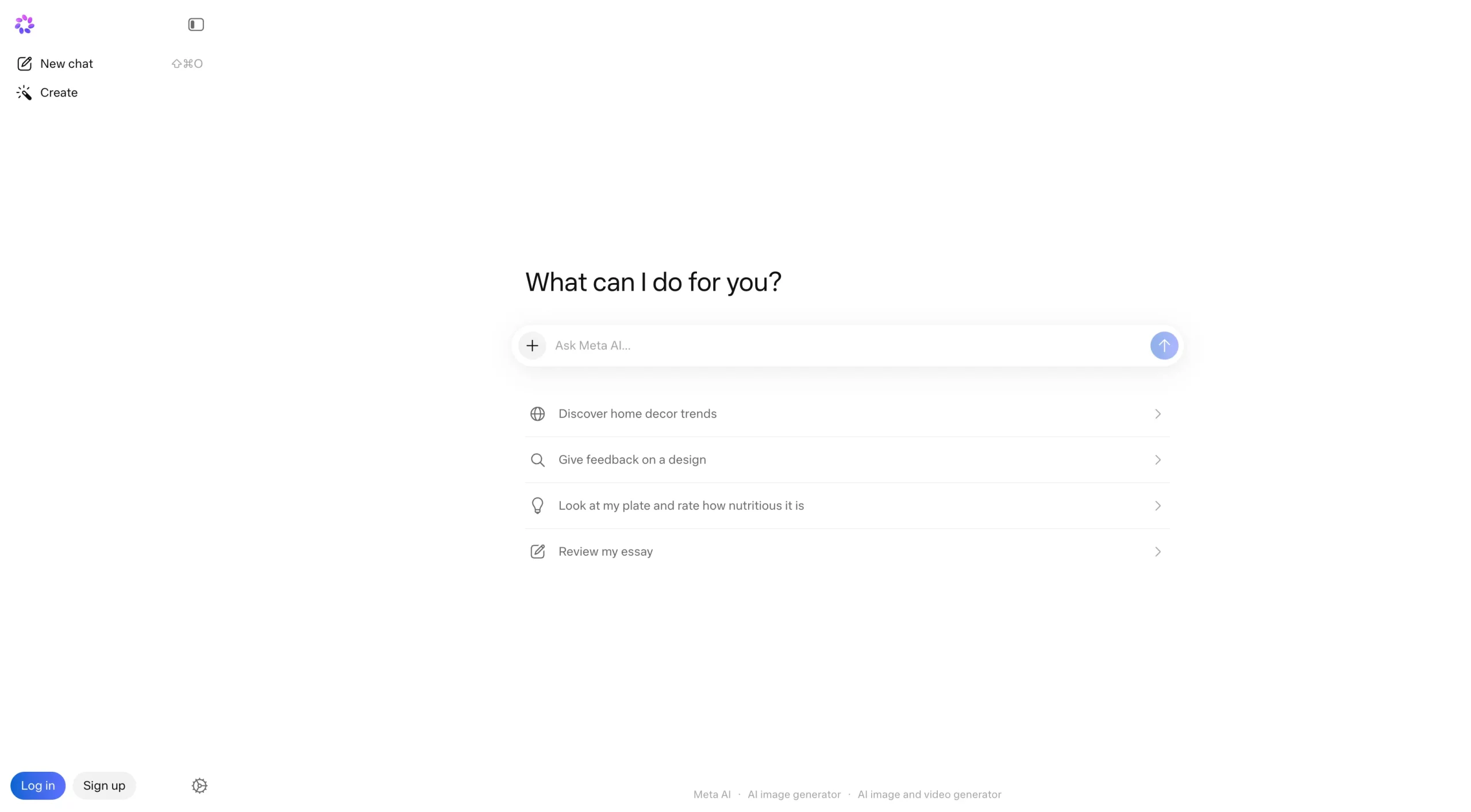
Once you access Muse Spark is when you will realise the true beauty of it. It brings back the traditional AI chatbot interface in a clean, minimalistic manner that shows no unnecessary options and tools to choose from. Just 2 modes – Create, or add Media/ Files to your chat. That’s it!
With this simplicity and its claims in mind, we put Muse Spark through a range of tests to check out its capabilities. Read on to find out how it performed
Prompt:
“Extract all the text from this image and frame a WhatsApp message to be forwarded across groups using the information.”
Output:
Observation:
Muse Spark handled the text extraction task competently and with good accuracy. The model successfully identified and pulled out all visible text from the image without missing key details. What stood out was how it went beyond a plain extraction, it reformatted the content into a conversational, forward-friendly WhatsApp message that felt natural and ready to share. While this was not a particularly challenging task, it does confirm that Muse Spark’s multimodal text recognition works reliably for everyday use cases.
Task 2: Multimodal Content Generation
Prompt:
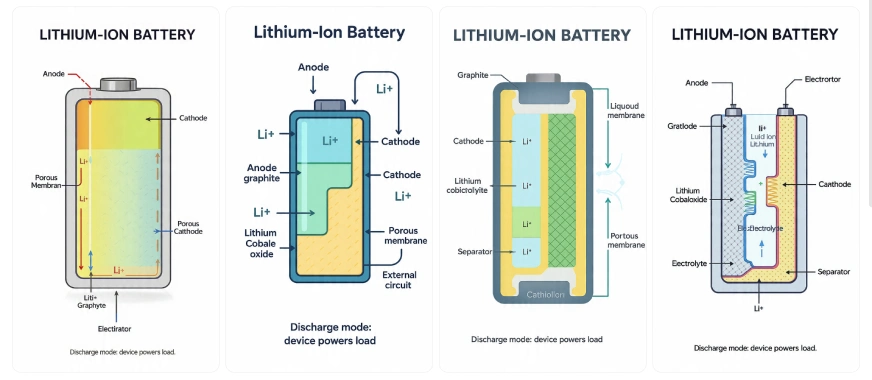
“Create an annotated diagram explaining how a lithium-ion battery works. Label all key components (anode, cathode, electrolyte, separator) and show the flow of ions and electrons clearly with arrows and short descriptions.”
Output:
Observation:
This is where Muse Spark genuinely impressed. The model generated a well-structured annotated diagram that correctly labelled all the requested components (anode, cathode, electrolyte, and separator) and used directional arrows to show ion and electron flow clearly. The descriptions accompanying each label were concise yet informative, making the diagram easy to understand even for non-technical users.
What added real value was the model offering multiple visual variations to choose from, giving users creative flexibility. The built-in animation option was a standout touch. Being able to bring a static diagram to life with a single button click makes this genuinely useful for designers, educators, and content creators alike.
Task 3: Health Queries
Prompt:
“Suggest me some great late night meal options for body recomposition with minimal carbs and fats and maximum amount of proteins”
Output:
Observation:
Muse Spark delivered a solid and well-organised response to the late-night meal query, correctly prioritising high-protein, low-carb, and low-fat options that align with body recomposition goals. The suggestions were practical, varied, and accompanied by enough context to be actionable. However, the experience hit a clear wall when the follow-up request to convert the information into an infographic was made. Despite two separate attempts and prompting, the model failed to produce the visual output. This is a notable gap, especially given that Meta has positioned health as one of Muse Spark’s core strengths. The ability to generate interactive health visuals is a claimed feature, and this failure to execute on a fairly straightforward infographic request suggests the capability is either inconsistent or still being refined.
Other Major Releases:
Conclusion
With Muse Spark, Meta has made its ambitions in AI unmistakably clear. The launch signals that Meta is not just investing in model research but is actively working to turn AI into a native layer across the apps that billions of people already use every day.
If Muse Spark delivers on that promise, this could become one of Meta’s most important AI launches yet. The model shows clear strength in the areas Meta has built it for, and the potential for impact at this scale is hard to overlook. As for now, Muse Spark looks quite potent and is a strong showing from the Meta Superintelligence Team.
Technical content strategist and communicator with a decade of experience in content creation and distribution across national media, Government of India, and private platforms









%202.jpg)