LinkedIn has introduced a unified integrations platform designed to standardize and reconcile hiring data across disparate systems, improving data quality, partner onboarding speed, and enabling downstream AI applications. The multi-year effort consolidates fragmented recruitment data pipelines into a consistent and scalable foundation for talent products and AI-driven features.
Recruiting at LinkedIn operates at a significant scale, ingesting data from applicant tracking systems, career sites, and job boards. These sources often produce inconsistent schemas and incomplete records, creating challenges for downstream analytics and product features. The platform addresses this by introducing a unified data model and integration layer that standardizes ingestion, reconciliation, and delivery of hiring data across systems.
Gaurav Sisodiya, Engineering Lead at LinkedIn, highlighted the design approach in a post, stating,
We designed for coexistence, not replacement.
According to LinkedIn, the platform has reduced partner onboarding time by 72% while expanding data coverage and improving completeness. This allows external partners and internal systems to integrate without requiring custom transformations, replacing previously siloed pipelines with a shared infrastructure.
We developed a unified integrations platform to standardize, reconcile, and deliver hiring data at scale.
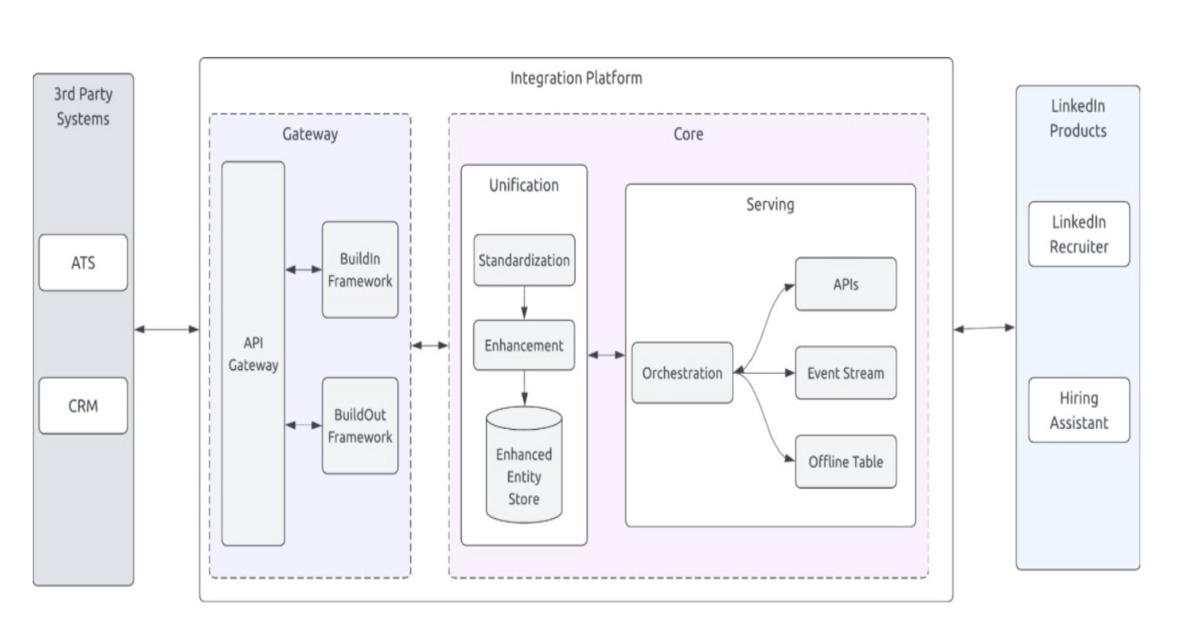
At a high level, the architecture is organized into three layers: standardization, orchestration, and enhancement. The standardization layer normalizes incoming data from heterogeneous sources into a consistent schema, abstracting differences across applicant tracking systems and job platforms. The orchestration layer manages workflows for ingestion, validation, and reconciliation, coordinating data movement and enforcing quality checks. The enhancement layer processes normalized data to address gaps, deduplicate records, and augment signals before making them available to downstream systems.
/filters:no_upscale()/news/2026/05/linkedin-unified-hiring-platform/en/resources/1linkedinunifiedhiring-1776925392829.jpeg)
High-level architecture (Source: LinkedIn Blog Post)
Aditya Hegde, Engineering at LinkedIn, described the underlying workflow in a post:
Under the hood: Temporal-orchestrated workflows, Kafka streams, record persistence in Espresso, multi-mode orchestration, and declarative schema/ID mapping enable replayable, bidirectional sync and safe evolution.
This structured data foundation enabled LinkedIn engineers to build a perception and action interface for the Hiring Assistant. Standardized hiring data allows AI systems to interpret signals across candidate profiles, job requirements, and recruiter interactions. The system aggregates signals and translates them into recommendations, automation, and decision support within recruiter workflows.
Ritvik Kar, Product at LinkedIn, noted the importance of system reliability, stating,
This is key without a highly reliable, observable, stable system that can deliver on high data availability and consistency across read and write, there’s no way for our customers to trust our platform and do their work seamlessly.
LinkedIn reports that the unified platform reduces duplication across integration pipelines and simplifies maintenance by centralizing data processing. The approach also improves data consistency for downstream analytics and AI systems that depend on shared hiring data across multiple sources.


