Part of the purpose of Google’s payments is to make Google the default ‘general search engine’ but part of them is also to stop device-makers experimenting with ideas that unbundle - ‘bleed off’ - things out of general search. That will change now, though of course whether it results in anything is, again, unclear.
Meanwhile, so far I’ve only been discussing Bing as the alternative, but for Apple, uniquely I think, there is also the option to create its own. The capital costs of building and running a search engine are too large for a startup, and for Samsung or Motorola (Lenovo) they’re too far out of scope: perhaps more importantly, as above, if a large sample of search queries is needed, neither of them have enough. One could consider Amazon and Meta here, but only Apple has both the money and the distribution: it can launch as the default on devices driving 30% of US search, giving it several times more query volume than Bing has ever seen.
(Note that Apple has some search activity data already: as per the screenshots above, it sees the queries, and knows which suggestions users choose, but it does not see which results people click once they’re on Google.)

This prompts an amusing dilemma for the DoJ: it is also suing Apple for abusing what it claims is a monopoly of ‘performance smartphones’ (a more challenging market definition than ‘general search engines’, incidentally). Now it wants more competition in search engines, but the most obvious way that such competition could emerge is for Apple to make its own new search engine the default on this ‘monopoly’ platform. (Microsoft of course already makes Bing the default search engine in the default browser on the dominant PC platform, but no-one seems to care.)
Would Apple do this, though? That’s another piece of corporate strategy game theory. It would no longer be giving up $20bn a year from Google (though it would be giving up whatever Microsoft was offering), but it would still need to spend billions of dollars a year on infrastructure and hire thousands more engineers, and find a way to make money from this. Would it reproduce search advertising, finding a way to reconcile that with its privacy branding (note that Google retains 18 months of search history by default)? Something else? And at the end, why? Why, other than the fact that Google’s search business is very profitable? No, that’s not a sufficient answer. Companies do not launch expensive and risky new projects only because a DCF shows a positive NPV, and Apple certainly doesn’t.
This reminds me a little of the ideas that floated around a few years ago that Apple would do some huge acquisition. Netflix! HBO! A record label! Peloton (no longer huge)! A bank! A telco! Yes, Apple has lots of money, and it could buy lots of things, some of which might even be accretive, but that capital has opportunity cost, Apple is a very narrowly-focused company, and adding thousands of new engineers and ad salespeople working on a new and basically unrelated product has an opportunity cost as well. As Tim Cook has put it a few times, the question is whether Apple could combine technology and experience to solve an important problem in a new way. I don’t think he would want to spend tens of billion dollars just to end up with an Apple version of Bing. That doesn’t solve a problem for anyone other than the DoJ.

Another possible approach, explored by the UK’s CMA (study (page 18), summary), is to go to the root of the natural monopoly - the query data - and require Google to provide this to its competitors on some sort of wholesale, anonymised basis. If the barriers to entry are the defaults (now blocked), the user data, and the capital costs, what if everyone could have the same data as Google? The EU’s DMA, equally, has a clause (61) saying that gatekeepers (ie. Google) are required to give third parties ‘ranking, query, click and view data’ but giving no indication of what precisely that means or how it should be done (this is a systemic problem with the DMA, which in trying to be broad and principles-based is often merely vague).
Providing this user data is a lot easier to say than to do, in a way that actually works. Would this data really be private? If it’s anonymous, how do you provide the history? Would it be useful without knowing all the other signal used? Should Google provide all of that too? Does this enable competition, or just create a class of ‘thin Google wrappers’ with no real innovation of their own? Would a US court want to mandate something that would require such detailed and highly technical ongoing scrutiny and management?
And yet…

We could have said all of this in 2020, when this case was filed, but the emergence of LLMs in the last two years has changed how people think about search itself. LLMs might produce better results, or different results, or different interfaces, and at any rate they represent a discontinuity, a market entry point, and a new opportunity and new way to persuade users to switch. That was (briefly) the idea behind Bing integrating LLM results at the beginning of 2023, and it’s behind the excitement in some quarters around Perplexity, while ChatGPT now has a private search trial. Are LLMs an end-run around Google’s reinforcement learning engine? A better way to understand pages? Does search still need that reinforcement learning?
I am rather skeptical about this: I think that at a minimum, ‘hallucination’ rates mean that LLM web search will need a huge amount of pre-processing and post-processing that’s actually best done by an incumbent (i.e. Google), but no-one really knows yet. These ideas certainly could change the balance of the question ‘should we set the default as Google or Bing?’ just at the moment that Google is no longer free to put $30bn in rev shares on the scale.
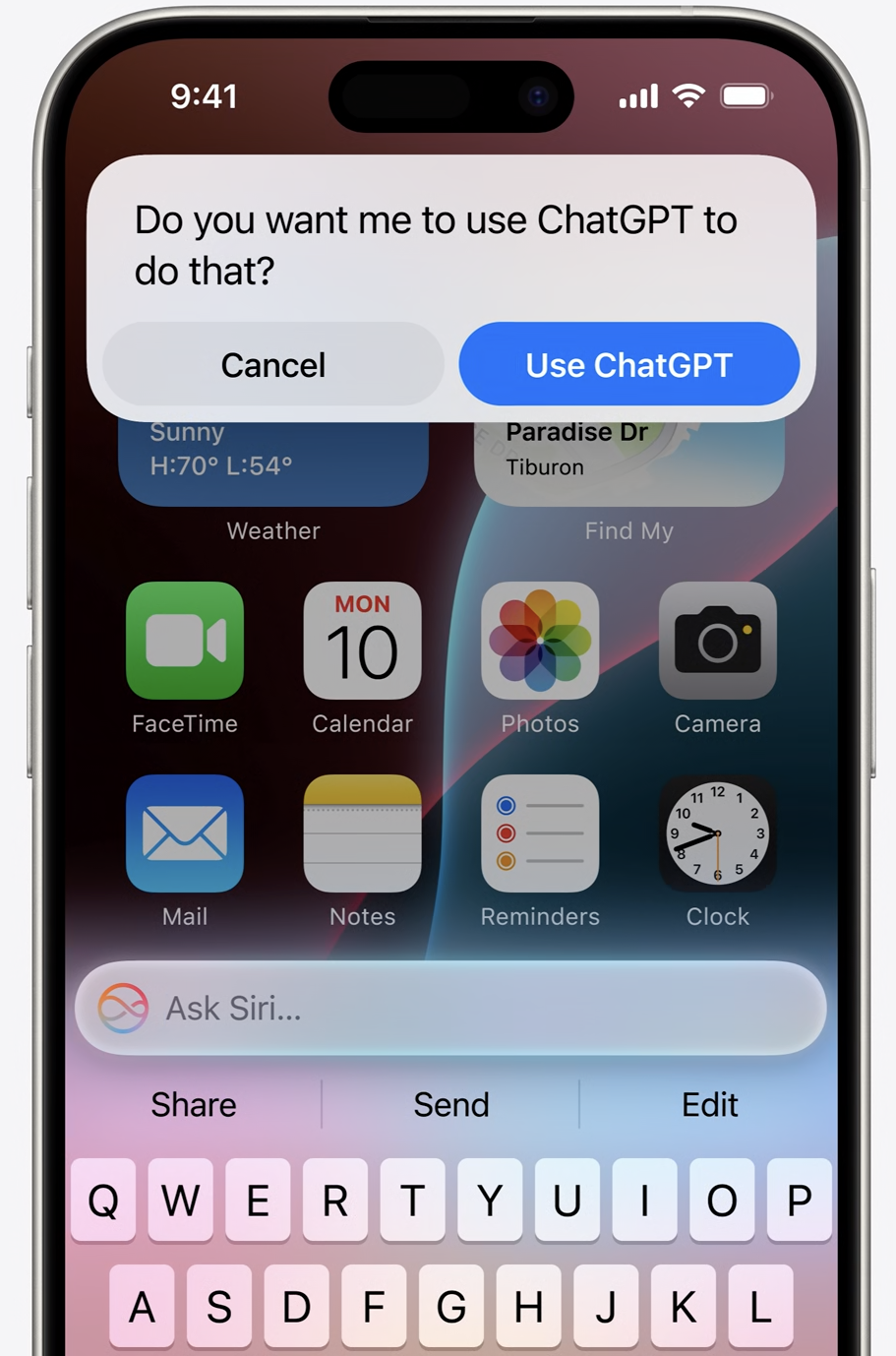
Meanwhile, even if you don’t think LLMs will replace Google as we know it, they can probably unbundle some of it. This winter, Apple will launch a new Siri that can send some classes of question to a ‘world model’ - for the moment, that will mean ChatGPT, but it could also be Gemini, Claude, Llama or Apple’s own foundation model (which is trained, incidentally, in Google’s cloud). Craig Federighi, Apple’s head of software, explicitly compared this to the Google integration in Safari.